Showing posts with label testing. Show all posts

Saturday, September 28, 2013

Planning Curiosity's First Scoop

Our first set of 5 science papers on results from scooping martian dirt with Curiosity were published this week.  Those results and papers seem so old to me; we got the data late in 2012 and wrote the papers last spring.  We are working on more papers with more detailed results.  This will likely continue for years or maybe even decades - like the Viking analyses.  But the specifics are new to everyone not on the team.  The excitement from the broader community is so fun to see.

Reading the papers and talking about the results (MP3 interview on Insight) brings back interesting memories.  Most of them are good.  But it was also very hard to identify all of the things that had to be done before we could scoop and analyze the samples.  I was intimately involved in that process, and fellow Long Term Planner (LTP), Sanjeev Gupta, captured me working with sol paths and contingencies in one of our daily meetings with the Strategic Uplink Lead (SUL Alicia) and Strategic Science Planner (SSP Greg).

Long discussions often lead to better plans.
White boards are essential!
In operations, the LTP, SUL, SSP, and others representing engineering and science instruments meet near the end of every day at the Look Ahead Plan Meeting (LAPM), and often earlier in day at informal tag-ups.  We shape the plans for Curiosity for the upcoming 1-7 sols.  This is easy when we are mostly driving, but it was extremely challenging for our first sample.  There were so many things we didn't know.  We did our best to make good plans and revised them every day until we got our sample and our results.

I went through a similar process for Waypoint 1 / Darwin, but in that case, I was the Point of Contact for science planning.  Thus, I did a lot of the planning even when I wasn't the LTP.  It was great to have a LTP take care of the daily planning while I focused on other details.  We'll likely use this approach going forward when we get to a place where we want to do intensive work.  It gets easier each time.

When I started this mission, I had no idea what it takes to ask a rover on another planet to do science for you.  I now have some idea, but every time I sit down with someone with different expertise than mine, I realize how much they know and contribute that I'd never dreamed of.  For example, it took strategic planning plus three expert rover planners and me and instrument Payload Uplink Leads plus many others all day to plan the contact science for one day at Darwin.  And that is using tools developed that week in response to need identified from our last contact science adventure.  And... and... and...  Each time we do this, we know more, we improve our approaches, we build better tools.  I don't think it will ever be easy, though.  We will always push for more; it seems to be in our natures.

What an amazing adventure to be exploring Mars with Curiosity!

Thursday, February 7, 2013

First Drilling on Mars!

http://mars.jpl.nasa.gov/msl/news/whatsnew/index.cfm?FuseAction=ShowNews&NewsID=1422


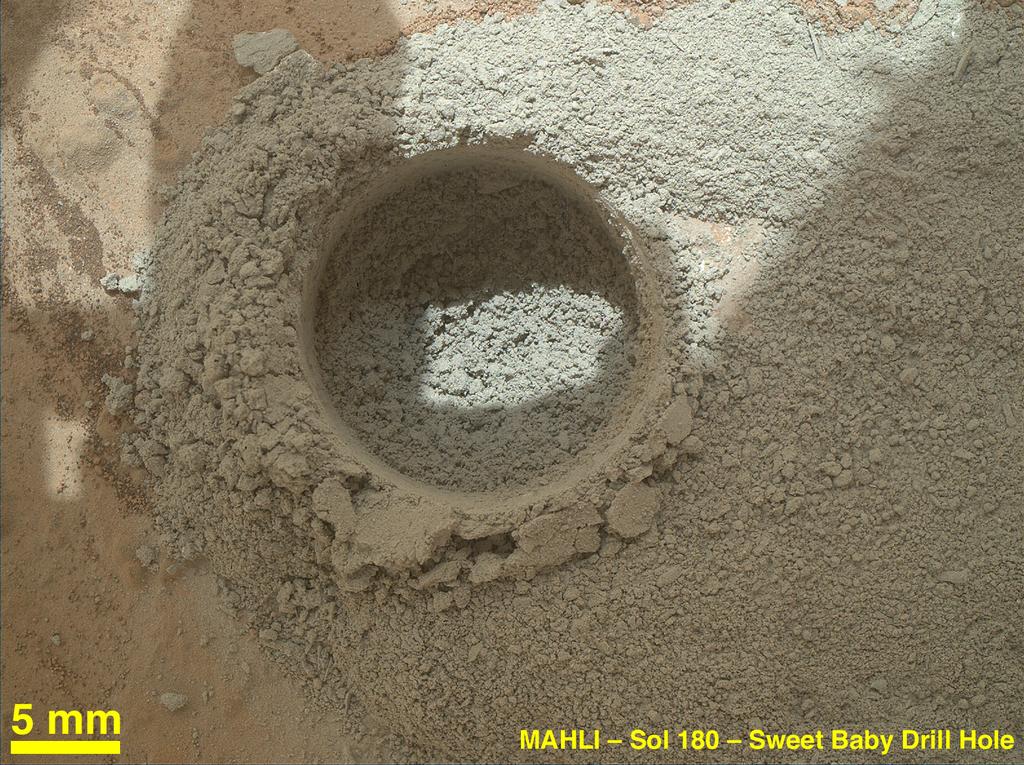
It's been two months since I last wrote an entry.  It's not that nothing has been happening - quite the opposite.  I've been trying to adapt to being back home and teaching while also helping run the Curiosity mission.  And Curiosity has been VERY busy.  Just this morning, we got confirmation that we've drilled a mini-hole in a rock on Mars.  It's about 1 cm deep and is both an engineering test and a bit-cleaning exercise.  The act of drilling removes contaminants from Earth off the bit.  The next step is to drill a 5 cm deep hole.  That one will send sample up through the drill bit, into the sample processing chambers, and eventually to the CheMin and SAM instruments for analysis.  We are really looking forward to know what minerals are present as well as what comes off the sample when we heat it for SAM.  This is really an exciting adventure.  Stay tuned!  There is likely to be a press conference soon!

By the way, this morning I did an interview on Insight, Capitol Public Radio.  Unfortunately, we didn't have confirmation of the first drill hole until 10 minutes before I went online, and I didn't have an internet connection.  Thus, I couldn't announce these great results there!

Friday, November 9, 2012

Dawn on Charlotte Talks, My NPR Interview

Curiosity's hand print in the soil of a wheel scuff.  The imprint is from the APXS instrument, which measured the elements (e.g. Si, Al, Mg, Fe, etc.) in the soil.

Earlier this week, I had the privilege of going to the annual Geological Society of America meeting in Charlotte, NC.  I presented our preliminary geological map of the Curiosity landing area in Gale Crater, Mars.

Thanks to Justin Samuel, of GSA, I was invited to record an hour-long NPR show with Mike Collins of Charlotte Talks.  It was great fun!  Here's the link: Mars Rover

Joy Cooke already posted a comment on the show asking if I encourage young students to pursue science (Thanks Joy!) - I do, but informally.  I try to share my experiences, but right now, I am almost entirely focused on making sure we use the rover for the best scientific purpose possible.  It's such a capable - and complicated - rover, that we have to have people dedicated to making all of the daily decisions on what to do - down to planning seconds, looking for swapped numbers, making tough choices about what to throw out of plans, etc.

For example, if a command has an error, it can put an instrument in an unsafe state. We then have to evaluate

  1. what happened, 
  2. whether or not any damage was done, 
  3. which data stored on Curiosity we need to request to diagnose the problem,
  4. how to fix the problem, 
  5. how to make up for the things Curiosity didn't do because of the error,
  6. how to change all the commands we were prepared to send to the rover (and make sure there aren't any new errors!)
  7. how to change the plan for the next day, 
  8. how to prepare for the Thanksgiving weekend (when most people actually get a holiday), and
  9. how to keep the problem from happening again
Yesterday, I worked over 12 hours on planning for the next few days plus Thanksgiving observations, and I wasn't the only one!  There were dozens of us.  

Eventually, we get to actually look at the amazingly cool data and learn something about Mars.  Often, the public has more time to look at the beautiful images than the people on the team!  I hope that all people of all ages can enjoy the sense of exploration, adventure, and discovery provided by the Curiosity rover!  It is an amazing international collaboration that people across the world can and should be proud of!

Saturday, September 22, 2012

Curiosity Scarecrow Rover


Yesterday, the shuttle Endeavor was delivered to LA.  It flew over a number of key areas in the state, including the Golden Gate Bridge, NASA Ames, Disneyland, and JPL.  Needless to say, many people at JPL wanted to see it.  We piled out of our meetings and chose a place with a good view of the sky.  Since JPL is built on the Sierra Madre Fault scarp, everywhere that isn't behind a tall building has a good view.  I chose to go to the Mars Yard - the place the rover drivers test the mobility of the "scarecrow" rover.  When the rover Opportunity got stuck in the sand on Mars, this is where the rover drivers spent a month studying how many wheel turns would be needed to get her unstuck - and it worked!

The Curiosity Scarecrow consists of the same suspension system as the real rover, but lacks all of the instruments.  One of the rover drivers decided that Curiosity Scarecrow also wanted to watch the shuttle fly over.  Thus, he drove her out, over some rocks, and into the center of the yard.  I took some good video of the rover and posted a cut version here:  


It was great to see the Curiosity Scarecrow creeping around - and going over some very interesting obstacles!

(My video and photos of the shuttle flyover aren't worth posting.)