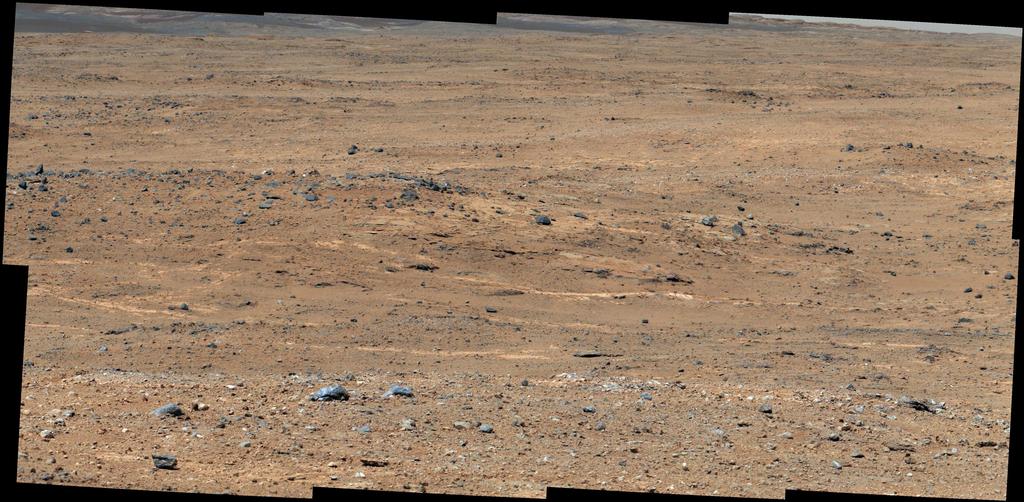
Over the last 4 weeks, I spent more than 100 hours preparing for our science campaign at "Waypoint 1", also called Darwin. (See the official press release for a summary of results.) This is one of a handful of sites that we chose in advance to spend some extra time for contact science on our <as fast as possible> drive to the base of Mt. Sharp. Along with Ken Williford, I volunteered to coordinate analyses at this first waypoint. There were several key goals for this site.
First, we know that the rocks are very interesting and only a fews sols won't get us very far in understanding all the rocks in the area. But we don't want to get bogged down in a long campaign of analyses because the base of Mt. Sharp is our prime science target. Thus, Ken and I, with the help of many others, tried to put together a plan that included identifying the site for contact science, approaching the site, bumping to our contact science location, and doing 3 days of "outcrop" science.
Second, we wanted as much scientific information as possible in our short stay here. Maximizing science return is different for different people with different interests. To start the planning off well, I encouraged the science team to identify the key science questions we could address at this site. Many team members stepped forward with presentations on scientific enigmas and the observations we needed to address them. We then settled on analyzing the composition and texture of conglomerates as our top science priority, with analyses of sandstones and mystery dark rocks as secondary targets.
Third, we decided that a good view is worth a lot, and there was a nice 3-m high, smooth hill with an amazing view of both the basin to the south of the official waypoint and what we hoped would be good areas to consider for contact science.
With these goals in mind, we headed toward the hill, named Panorama Point, expecting that it would not cost us any extra sols to get there rather than go straight to the contact science area. As luck would have it, full fledged AutoNav was approved the day before our drive toward Panorama Point, the terrain was perfect for a long AutoNav drive, and we got to almost the top with a record-breaking drive (141.5 m!). It was also right before a weekend, which meant we would have the weekend at the top of the hill for some stereo panoramic images, opportunistic contact science, and our approach to the contact science area. On top of all that extra time at a great place (rather than a miscellaneous place), we got to our contact science area several sols earlier than we were planning! This meant that Ken and I, and the rest of the team had to move into hyper planning mode, making decisions a week earlier than we expected.
This acceleration in schedule meant that we also got some extra science at the prime contact science location at no cost to drive progress beyond that already planned. We were in what we call "restricted sols", which means that we only get our data down from Curiosity after we have to make a plan for the next day. This really slows us down when we are driving, because we can only drive every other sol. However, when we are doing contact science in one spot, we can do useful analyses every sol. Thus, I really wanted to get to the contact science area during restricted sols, which we did. That means that we could bump to one site and do some analyses while waiting for the data we needed to get to the second site (which had better outcrop in my opinion). Thus, we ended up with more contact science and two sites at the cost of no drive sols (or maybe 1 drive sol, depending on how you count). This was a huge accomplishment for the team. We took a record number of MAHLI images and did 8 analyses with APXS. And we left the site on schedule with no problems. And we ended just as restricted sols ended. Thus, we are back to Drive, Drive, Drive every day!
To see our data, check out the images at http://mars.jpl.nasa.gov/msl/multimedia/raw/?s=#/?slide=385 starting with sol 385 for tons of AutoNav drive images and going up to sol 402 with our last HazCam picture of the outcrop at site 2. Spend some time with 100's of images! And remember - they are from Mars!
Showing posts with label MastCam. Show all posts
Showing posts with label MastCam. Show all posts
Monday, September 23, 2013

Tuesday, September 10, 2013
Curiosity's Longest Drive Yet!
 |
| The "Darwin" Outcrop |
Curiosity did its longest drive yet late last week: Press release. It was beautiful!
I spent the last two weeks at the on-duty Long Term Planner, plus helping the team develop our science priorities for analyses at Waypoint 1, our first significant stop on the way to Mt. Sharp.
It has been intensely rewarding to see the amazing images come down. We chose this area as one of our 5 places to do more intense science because we expected reasonably good outcrop of the rocks that make up Bradbury Rise based on images from the orbiting instrument HiRISE. And we chose well!
Images:
http://mars.jpl.nasa.gov/msl/multimedia/raw/?s=#/?slide=388 (more full frame images will come down over the next few days)
Sunday, August 25, 2013
Curiosity in 3D in KeckCAVES!
This is super cool, but my real dream is to have an animated Curiosity (e.g. turning wheels, pointing cameras, moving arm, etc.) to walk around with through Gale Crater and up the slopes of Mt. Sharp on real HiRISE and MastCam data! It's close to possible - we just need a really good computer science graduate student and some $$ to pay them!
Wednesday, December 12, 2012
A special post for Bill and Bruce
I was sitting in the Davis train station waiting for my train home, typing a summary of today's Science Discussion, when an old friend sat down across from me. Bill Cotton! A retired conductor and "legend of the Amtrak line", Bill knew everyone by name and still remembers most of us regular riders. He said he is meeting Bruce, another conductor, tomorrow. Bruce and I talked a lot about Mars when I first became part of the MastCam/MAHLI/MARDI camera team for Curiosity. I gave Bill my blog address and asked him to pass it on to Bruce. After talking a bit more, I said I'd add a link to the great images in the JPL press releases, so here it is, Bill: http://mars.jpl.nasa.gov/msl/news/whatsnew/ It's so great to have run into you!
Now it's back to that summary of today's Science Discussion, with an even bigger smile on my face!
Now it's back to that summary of today's Science Discussion, with an even bigger smile on my face!
Subscribe to:
Posts (Atom)