Monday, November 26, 2012
Engineers Talk EDL
I don't normally pay attention to GQ (the magazine, not another NASA acronym), but here's something you want to read: http://www.gq.com/moty/2012/nasa-spacemen-of-the-year-2012 It's some of the MSL engineers reminiscing about Curiosity's landing. Each adds their own take as they reconstruct the events. It was an amazing night!

Friday, November 9, 2012
Dawn on Charlotte Talks, My NPR Interview
 |
| Curiosity's hand print in the soil of a wheel scuff. The imprint is from the APXS instrument, which measured the elements (e.g. Si, Al, Mg, Fe, etc.) in the soil. |
Thanks to Justin Samuel, of GSA, I was invited to record an hour-long NPR show with Mike Collins of Charlotte Talks. It was great fun! Here's the link: Mars Rover
Joy Cooke already posted a comment on the show asking if I encourage young students to pursue science (Thanks Joy!) - I do, but informally. I try to share my experiences, but right now, I am almost entirely focused on making sure we use the rover for the best scientific purpose possible. It's such a capable - and complicated - rover, that we have to have people dedicated to making all of the daily decisions on what to do - down to planning seconds, looking for swapped numbers, making tough choices about what to throw out of plans, etc.
For example, if a command has an error, it can put an instrument in an unsafe state. We then have to evaluate
- what happened,
- whether or not any damage was done,
- which data stored on Curiosity we need to request to diagnose the problem,
- how to fix the problem,
- how to make up for the things Curiosity didn't do because of the error,
- how to change all the commands we were prepared to send to the rover (and make sure there aren't any new errors!)
- how to change the plan for the next day,
- how to prepare for the Thanksgiving weekend (when most people actually get a holiday), and
- how to keep the problem from happening again
Yesterday, I worked over 12 hours on planning for the next few days plus Thanksgiving observations, and I wasn't the only one! There were dozens of us.
Eventually, we get to actually look at the amazingly cool data and learn something about Mars. Often, the public has more time to look at the beautiful images than the people on the team! I hope that all people of all ages can enjoy the sense of exploration, adventure, and discovery provided by the Curiosity rover! It is an amazing international collaboration that people across the world can and should be proud of!
Saturday, November 3, 2012
Self Portrait of Curiosity!
We used MAHLI, the Mars Hand Lens Imager, to image Curiosity on Mars! MAHLI is on the end of the arm, so to take the self portrait, we had to command the arm to move to a couple of dozen different places, pointing MAHLI precisely. Several team members spent hours and hours preparing the sequence of images, testing it on Curiosity's Earth-bound twin, and then implementing it on Curiosity. The result is spectacular, even in low resolution thumbnail mode!

Analyzing Mars
In the last week, we announced results from both of our large analytical instruments on Curiosity.

CheMin characterized the mineralogy of dust and sand at the site called Rocknest. CheMin uses x-ray diffraction patterns to measure the spacing between atoms in crystals, which are diagnostic of specific minerals. Some of the CheMin team members have been working for more than 2 decades to get x-ray diffraction on Mars! This first sample analysis is a spectacular achievement.
Similarly, SAM characterized the composition of the martian atmosphere. The SAM team looked for methane, a trace gas that some have suggested is present based on observations from Earth and a Mars orbiter. However, those detections have been very controversial. The SAM team announced that they did not detect martian methane in the atmosphere. SAM did, however, refine estimates of the amount of 13C versus 12C in carbon dioxide as well as the concentration and isotopic ratios of argon. These results are critical for understanding the history of the martian atmosphere, in particular why it is thin and how much of it might have been lost to space over the last several billion years.
SAM has not yet analyzed the dust and sand that CheMin has analyzed. Those analyses are in the works and will represent another important milestone for our mission.
On a personal note, I'm heading to the annual meeting of the Geological Society of America. There is a special session on results from the Mars Science Laboratory, and I'll be presenting our geological map on Monday morning. It will be great to share our results with our colleagues!
CheMin characterized the mineralogy of dust and sand at the site called Rocknest. CheMin uses x-ray diffraction patterns to measure the spacing between atoms in crystals, which are diagnostic of specific minerals. Some of the CheMin team members have been working for more than 2 decades to get x-ray diffraction on Mars! This first sample analysis is a spectacular achievement.
Similarly, SAM characterized the composition of the martian atmosphere. The SAM team looked for methane, a trace gas that some have suggested is present based on observations from Earth and a Mars orbiter. However, those detections have been very controversial. The SAM team announced that they did not detect martian methane in the atmosphere. SAM did, however, refine estimates of the amount of 13C versus 12C in carbon dioxide as well as the concentration and isotopic ratios of argon. These results are critical for understanding the history of the martian atmosphere, in particular why it is thin and how much of it might have been lost to space over the last several billion years.
SAM has not yet analyzed the dust and sand that CheMin has analyzed. Those analyses are in the works and will represent another important milestone for our mission.
On a personal note, I'm heading to the annual meeting of the Geological Society of America. There is a special session on results from the Mars Science Laboratory, and I'll be presenting our geological map on Monday morning. It will be great to share our results with our colleagues!
Wednesday, October 17, 2012
Jake, Glenelg, and Mugearite
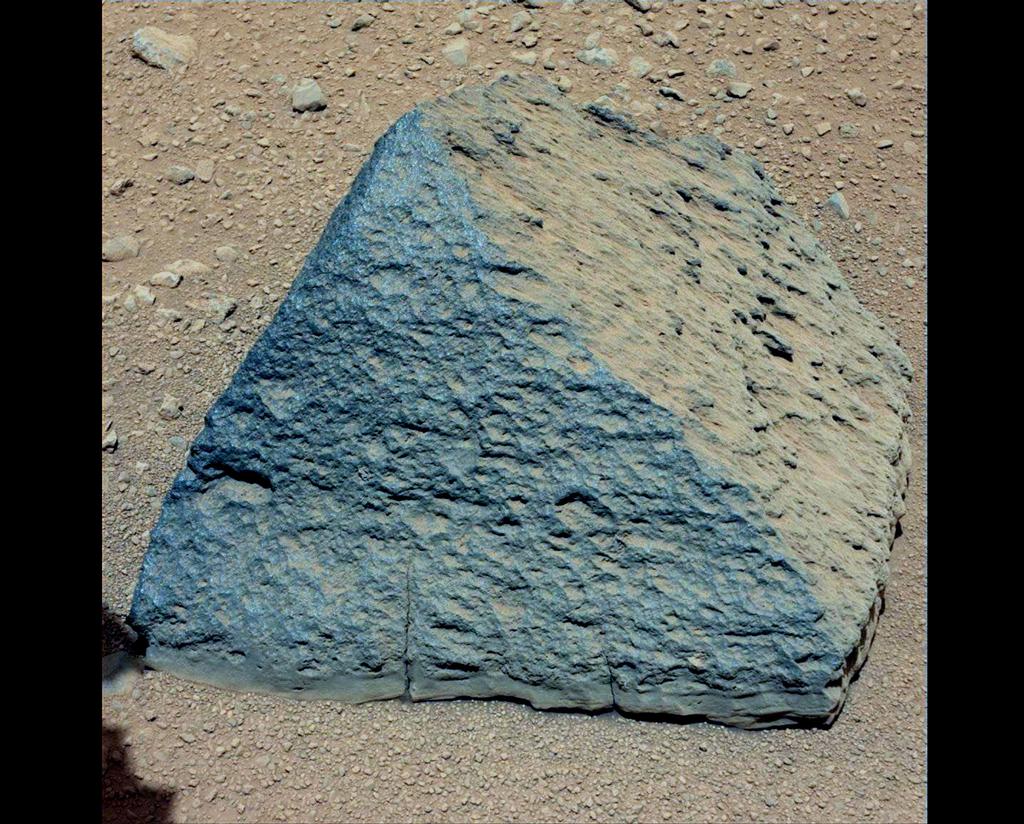
Here is a great blog about the fun of names on Mars, particularly the rock named Jake. http://www.bbc.co.uk/news/19979798
We name things on the MSL mission because it's easier to understand someone when they say "Jake" rather than "That rock we analyzed on sol, hummm, maybe sol 48. The one that looked like a pyramid."
Geologists do this with formations (groups of rocks) on Earth all the time. Almost all formation names on Earth are taken from nearby places, a tradition also codified by official naming organizations such as the International Stratigraphic Commission. We are now doing it on Mars, but we have to name the places before we can name the rocks.
We're bootstrapping our way on the naming business. First, we identified interesting geological formations on Earth that have the same name as a city with a population of <100,000 people. We can then follow International Astronomical Union naming conventions and name a small crater after the city. We then name the quad (a ~1.2 x 1.2 km2 area) containing the crater after the crater, which is named after the city, which has the same name as the geological formation, which is named after a place where the formation is found, which is named after a person, another place, or whatever it reminded the namer of... This naming approach provides a very rich history from which people can make all sorts of interesting connections!
I have to admit that the fact that we found mugearite on the way to Glenelg, both ultimately linked name-wise to the Isle of Skye, does seem like a "cosmic coincidence!"
Saturday, September 22, 2012
Curiosity Scarecrow Rover
Yesterday, the shuttle Endeavor was delivered to LA. It flew over a number of key areas in the state, including the Golden Gate Bridge, NASA Ames, Disneyland, and JPL. Needless to say, many people at JPL wanted to see it. We piled out of our meetings and chose a place with a good view of the sky. Since JPL is built on the Sierra Madre Fault scarp, everywhere that isn't behind a tall building has a good view. I chose to go to the Mars Yard - the place the rover drivers test the mobility of the "scarecrow" rover. When the rover Opportunity got stuck in the sand on Mars, this is where the rover drivers spent a month studying how many wheel turns would be needed to get her unstuck - and it worked!
The Curiosity Scarecrow consists of the same suspension system as the real rover, but lacks all of the instruments. One of the rover drivers decided that Curiosity Scarecrow also wanted to watch the shuttle fly over. Thus, he drove her out, over some rocks, and into the center of the yard. I took some good video of the rover and posted a cut version here:
It was great to see the Curiosity Scarecrow creeping around - and going over some very interesting obstacles!
(My video and photos of the shuttle flyover aren't worth posting.)
Thursday, August 23, 2012
Finding the Path
Today was a great day. It was the first of four sols (martian days) that I am assigned to the tactical Long Term Planner (LTP) role, which means I attend meetings and am generally responsible for communicating LTP decisions to the relevant people.
It was also a hard day. The team has been working hard to find the right order and timing of activities over the next few sols. The LTPs have been making sol trees showing the various choices, considering the engineering constraints, and trying to optimize the outcomes of various necessary activities. The decisions were so complicated that we have had more than two significant plan revisions per sol for several sols. We finally found the right order for things just in time for solorrow (tomorrow's sol)! We knew it was right when each person we consulted provided more insights that supported the new plan rather than requiring changes. Whew!
At the end of my shift, after writing my notes, I send an e-mail updating a number of people on the new plan for Sol 19 (solorrow). One of the instrument Principle Investigators thanked me for my patience, and here is my response:
I don't feel like it was so much patience as finally feeling the path under our feet. In the late 1980's, I went on a hike up Mt. Baldy (just to the east of us here in Pasadena) and started to watch the sunset from the top with some friends. Then we realized that none of us had flashlights. We ran down as fast as we could with the remaining daylight. Then it got dark and we got to a wooded area. We lost the trail. I stayed in place while my friends when off in different directions looking for the trail. My philosophy was that I must be really close to the trail as one can't go very far off the trail in the dark. It turned out that it was only a foot to my right. Today was like that. We've been running around, trying to find the right path. Suddenly, things came together, and we got back on it. There is still a lot of work to get down off the mountain, but we have a plan that will keep us moving forward. I really like days like today...
For my next birthday, soon after that mountain trip, my dad gave me a day pack with a matching flashlight. I've almost always had a flashlight with me since then.
And reading my response now, I think I should say "There is still a lot of work to get to the mountain" since Curiosity is not yet even at the base of the trail up. Mt. Sharp is beautiful and it calls my spirit of adventure!
And reading my response now, I think I should say "There is still a lot of work to get to the mountain" since Curiosity is not yet even at the base of the trail up. Mt. Sharp is beautiful and it calls my spirit of adventure!
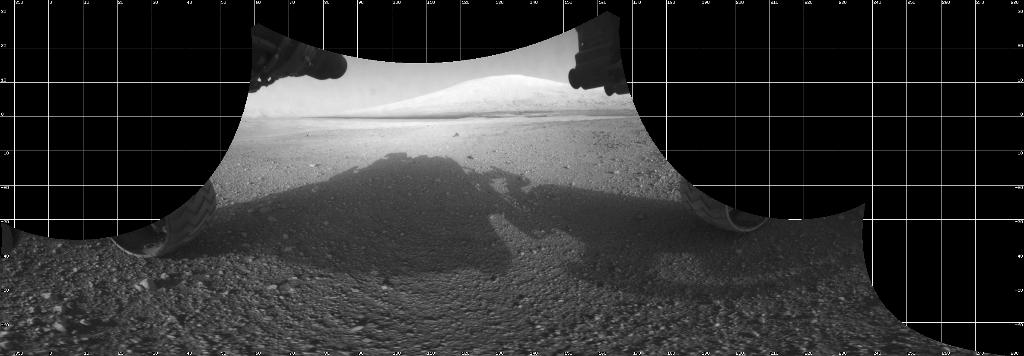 |
| HazCam mosaic of Curiosity's shadow and Mt. Sharp. Photo Credit: NASA/JPL-Caltech |
Subscribe to:
Posts (Atom)